
How to Read Your Pension Statement
“Understanding your pension statement is essential for protecting your retirement savings. Learn how to interpret the four key lines on your statement, verify your contributions against your payslips, and identify errors before they become costly problems.”
How to Read Your Pension Statement
Four lines, all already net of charges — and one you can check yourself.
Most members open a pension statement, look at the number at the bottom, and close it. That figure is the end of a story, and the lines above it are where mistakes hide.
The Four Lines Your Statement Shows
Your Standard Pensions Trust statement answers four important questions, in order.
- Opening balance — what you held at the start of the period.
- Contributions received — what actually reached your account.
- Investment income — what you earned or lost, after charges.
- Closing balance — what you hold now and next period's opening balance.
If the numbers do not add up, ask Standard Pensions Trust. The most important line is Contributions Received, because it is the only figure you can independently verify using your payslips.
The Line You Will Not See: Charges
Four parties are paid to run your pension scheme: the trustee, the fund manager, the custodian bank, and the National Pensions Regulatory Authority (NPRA).
Together, they charge approximately 2.5% per year of your fund balance, accrued daily (about 0.00685% per day).
You will not see these charges as a separate line on your statement because they are deducted before investment income is calculated.
In Ghana, Under Act 766
Your pension statement is not a courtesy; it is your legal entitlement.
Under Act 766, Section 105, Tier 2 schemes must keep proper records of every member's contributions.
Employers are required to remit contributions within 14 days after month-end (Section 63), which means a very recent month may still be in transit.
Where contributions genuinely go unpaid, the law imposes a 3% monthly penalty and allows recovery under Section 64.
Read It Now, Not at Retirement
Errors are easiest to correct while records are fresh. Four common issues continue to appear:
- A name different from your identity documents.
- An incorrect or transposed SSNIT number.
- An outdated employer after changing jobs.
- Months deducted but not credited.
A mismatched name or SSNIT number can quietly delay benefit claims decades later, long after the payroll officer who could have corrected the error has left.
Akosua Counts Her Payslips
Akosua's annual statement shows:
- Opening balance: GH¢12,000
- Contributions: GH¢3,300
- Investment income: GH¢1,450
- Closing balance: GH¢16,750
Everything adds up, so she almost stops checking.
Then she reviews her payslips. Twelve months at GH¢300 equals GH¢3,600.
One month's contribution is missing. That could be a timing issue—or it might not be.
Rather than guessing, she raises the matter with HR and provides her dated payslips.
(Illustrative example only.)Key Takeaway
Every figure on your statement is already net of charges, so the closing balance is genuinely yours.
However, a statement that adds up is not necessarily complete. Always compare "Contributions Received" with your payslips.
If the numbers do not match, ask questions.
What You Should Do Next
Main Action: Open your latest pension statement, review all four lines, and compare "Contributions Received" with your payslips for the same period.
- Check your name, date of birth, SSNIT number, and employer details against your official identity documents.
- Update your records through the Member Portal or Standard Pensions Trust's official channels.
- If a contribution is missing, contact your employer or HR first and keep your dated payslips as evidence.
- If unresolved, escalate the matter to Standard Pensions Trust and then the NPRA.
Respond to this article with emojis
0 reactions so far
Related Posts

Inflation and Retirement: The Silent Risk to Your Future Income
Learn how inflation can reduce the real value of your pension in Ghana, how Tier 1 and Tier 2 are affected, and what you can do to protect retirement income.
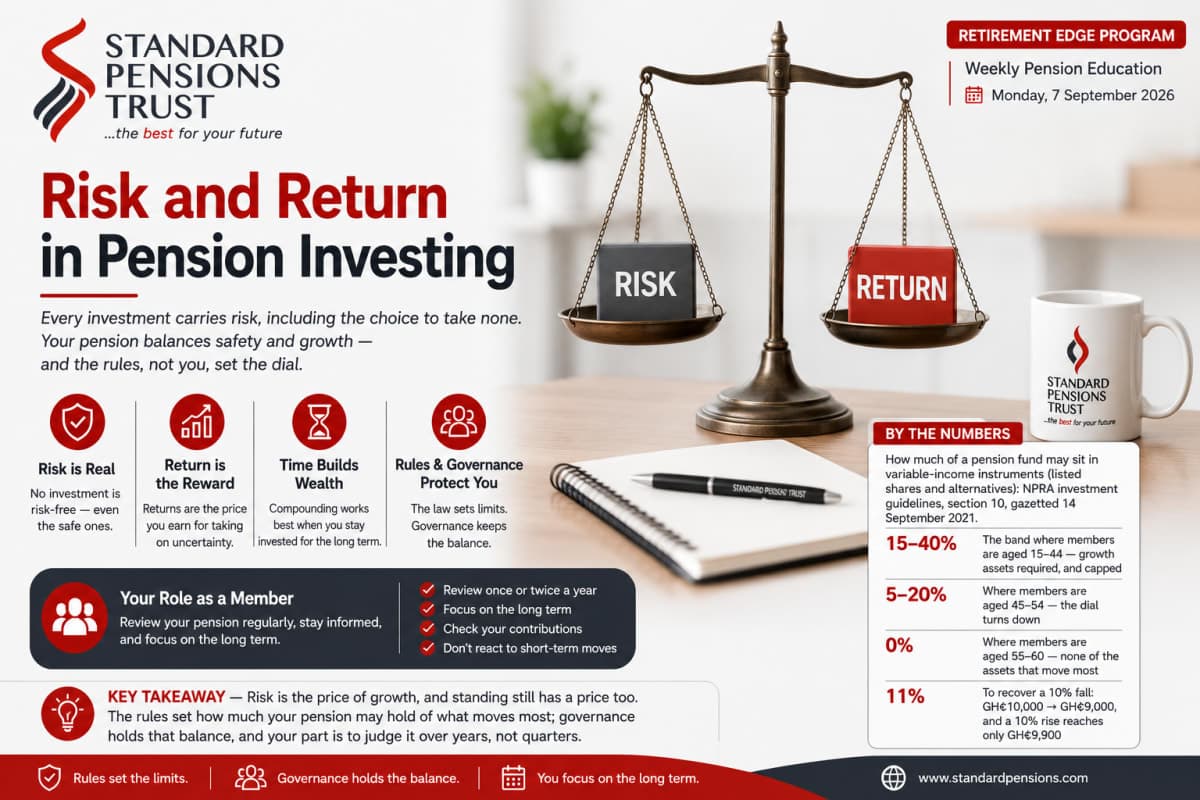
Risk and Return in Pension Investing
Your pension is designed to balance safety and growth. But what does investment risk really mean, and how do pension funds manage it? This week's Retirement Edge explains the relationship between risk, return, diversification and your long-term retirement savings.

Pension Transparency: What Members Should Expect from Their Trustee
Transparency is a duty you can test, not a favour you receive. Learn what you should expect from your pension trustee, from clear statements and accurate records to accessible information, member support and education.



Subscribe to our Newsletter
Get pension updates, retirement planning tips, and trusted insights delivered to your inbox.