
Risk and Return in Pension Investing
“Your pension is designed to balance safety and growth. But what does investment risk really mean, and how do pension funds manage it? This week's Retirement Edge explains the relationship between risk, return, diversification and your long-term retirement savings.”
RETIREMENT EDGE
Risk and Return in Pension Investing
Every investment carries risk, including the choice to take none.
Every investment carries risk, including the choice to take none. Your pension balances safety and growth — and the rules, not you, set the dial.
"Safe" and "growing" sound like opposites, so members ask which one their pension is. It is both; the rules hold the two in balance.
Every Investment Carries Risk, Even the Careful Ones
A return is what an investment pays for carrying uncertainty. Shares move with markets.
Government of Ghana securities pay interest and form a pension fund's lower-risk core, yet when rates rise the price of a bond you hold falls.
Even idle money carries one: inflation eats into what it buys. No option is without risk — only different risks and rewards.
Volatility Is Movement; Growth Is Direction
Markets move in cycles, so every fund has strong and weak periods: a quarter shows movement, decades show direction.
Compounding — returns earning further returns — needs time, and over a working life often adds more than the contributions.
Time also changes what a fall means: a 10% fall takes GH¢10,000 to GH¢9,000, and recovery needs about 11%, not 10%.
The 10% Fall Example
GH¢10,000 → GH¢9,000 after a 10% fall.
To return from GH¢9,000 to GH¢10,000 requires approximately 11% growth.
With thirty years to retirement there is time for that; with two, there may not be — and nothing makes it certain.
What markets did before is no promise of what comes next, and no one can promise you a return.
Discipline Keeps the Balance; Governance Holds It
The costliest mistakes are behavioural: reacting to a dip, chasing last year's winners, too cautious young or too bold near retirement.
Your part is modest: review once or twice a year, and judge results over several years, after charges and against inflation.
Your trustee is a fiduciary, bound by law to act in members' interests: it must keep an investment policy statement, diversify the fund to minimise investment risk and lodge audited investment reports under Act 766, §121.
Breaching the investment rules is an offence under §181.
Safety and Growth, Balanced by Rule
That balance is set by rule.
The NPRA investment guidelines cap how much of a pension fund may sit in "variable-income instruments" — listed shares, and alternatives such as property and infrastructure — the assets that move most and grow most.
The caps are graded by the age of the members the money is held for:
15% to 40%
At the youngest end.
5% to 20%
Mid-career.
0%
From age 55.
The closer members are to drawing their savings, the less of what moves most the fund may hold.
That grading is required by the guidelines and governs how the fund is invested — not a personal portfolio you hold or pick.
What This Means for You
You do not choose individual investments inside the scheme. Your pension is managed according to the approved investment framework, with risk and diversification considered by the trustee and investment managers.
What you can do is understand where your pension is invested, review your statements, and pay attention to how your fund is performing over time.
Do not judge your pension by one good month or one bad month. Pension investing is a long-term process designed around your working life and eventual retirement.
Key Takeaway
"Risk cannot be removed from investing. It can only be understood, managed and balanced against the return needed to grow your retirement savings."
What You Should Do Next
1. Know Your Fund
Check your latest pension statement and understand which scheme and fund your pension belongs to.
2. Think Long Term
Avoid making decisions based solely on short-term market movements. Pension investing is intended for the long term.
3. Ask Questions
If you do not understand your pension statement, investment information or how your fund is performing, ask your trustee for clarification.
4. Review, Don't React
Review your pension periodically, but avoid reacting to every short-term change in investment values.
A temporary fall in value does not automatically mean that your pension strategy has failed. What matters is how risk is managed and how the fund performs over the period for which your pension is being invested.
In Ghana, Under Act 766
Pension investment is governed by the National Pensions Act, 2008 (Act 766) and the applicable investment guidelines issued by the NPRA.
The trustee has responsibilities relating to the management and investment of pension scheme assets, including maintaining an investment policy and ensuring that the scheme operates within the applicable investment framework.
The purpose of these requirements is not to eliminate investment risk. Rather, they provide a framework for managing risk, diversification and the protection of members' retirement savings.
The Bottom Line
Pension investing is a balance.
Too much focus on safety can limit growth. Too much exposure to risk can create unnecessary volatility. The objective is to manage both within the rules while keeping the long-term purpose of the pension fund in view.
As a member, you do not need to become an investment expert. You do need to understand the basics, review your information and ask questions when something is unclear.
Your retirement savings deserve that level of attention.
This material is provided for general pension education only and is not personalised financial, investment, tax or legal advice.
Investment values can rise and fall, and past performance is not a guarantee of future results. Members should refer to their scheme information and seek appropriate professional advice where necessary.
Respond to this article with emojis
0 reactions so far
Related Posts
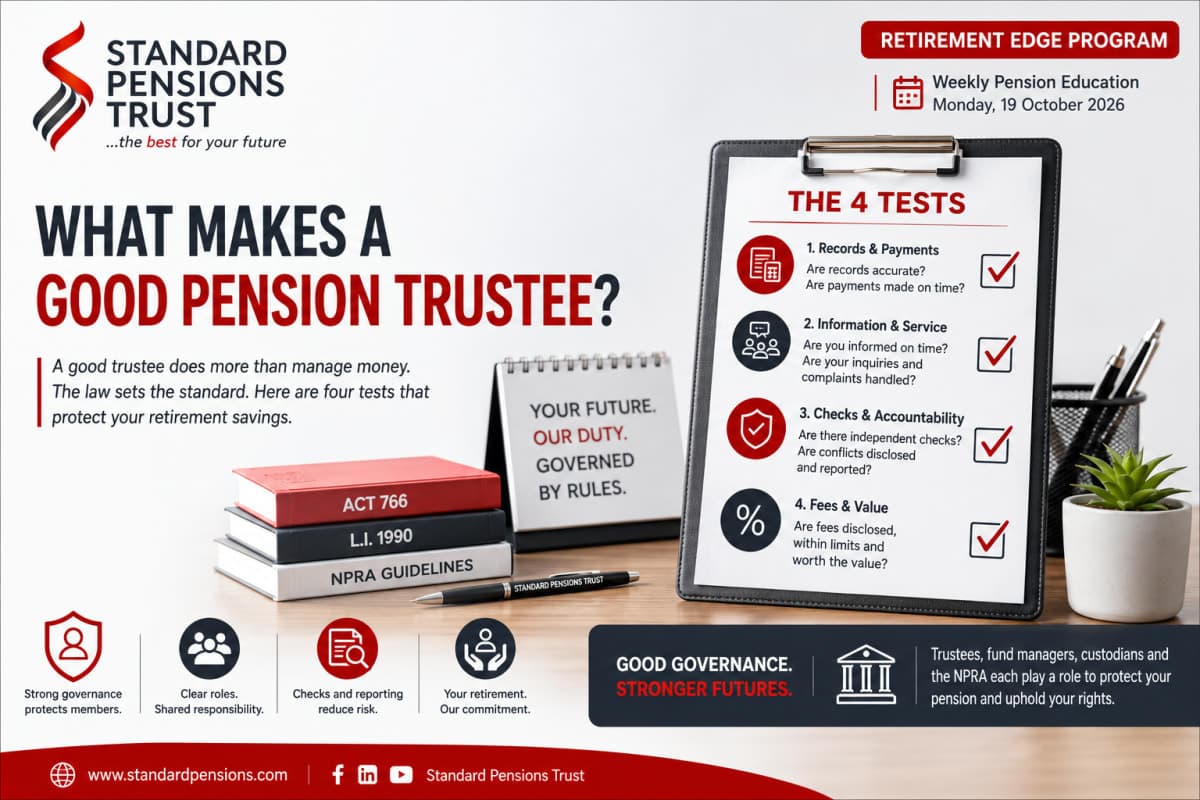
What Makes a Good Pension Trustee? 4 Regulatory Tests Beyond Fees
Fees are easy to compare, but they cannot tell you whether your pension records are accurate or your complaints addressed. Discover the four core legal tests under Ghana’s Act 766 and NPRA guidelines to properly evaluate your pension trustee

Pension Governance: Who Protects the Member’s Interest?
Who is responsible for protecting your pension? Discover how trustees, fund managers, custodians and the NPRA work together to support accountability and protect pension members in Ghana. This week’s Retirement Edge explains the roles behind pension governance and what you can do to stay informed about your retirement savings.

Why Every Workplace Needs Pension Education
Pension documents may arrive on a legal clock, but understanding them requires more than delivery. Discover why timely pension education helps employees understand contributions, statements, porting, and their retirement benefits.



Subscribe to our Newsletter
Get pension updates, retirement planning tips, and trusted insights delivered to your inbox.