
Inflation and Retirement: The Silent Risk to Your Future Income
“Learn how inflation can reduce the real value of your pension in Ghana, how Tier 1 and Tier 2 are affected, and what you can do to protect retirement income.”
Inflation and Retirement: The Silent Risk to Your Future Income
Your balance is a number. What it will buy is a different number, and it is the only one that decides how you live. Inflation is the rate at which prices rise, so the same savings buy less each year. Nothing on your statement shows this happening.
Ghana has already shown you the size of it
Take the Bank of Ghana's own December figures. Prices rose 23.2% in 2023, 23.8% in 2024 and 5.4% in 2025. Over those three years together, what GH¢1,000 could buy at the end of 2022 cost GH¢1,608 by the end of 2025. A balance that sat still lost almost four cedis in every ten. Merely to stand still it had to grow 60.8%. Prices are rising slowly now — 5.0% in August 2026 — and that is exactly when this risk is easiest to forget.
Only one part of your pension is reviewed by law
Act 766 has exactly one provision that raises a benefit after it is in payment. It is section 80, and it sits in the Tier 1 part of the Act. It requires SSNIT to review the monthly pension every year, indexed to wage inflation among active members or another rate the Trust sets with the NPRA Board. For 2026 that rate was 10%, against inflation of 5.4% at the end of 2025.
Your Tier 2 benefit is different by design: section 101(1) pays the entire accrued benefit as a lump sum, and no provision anywhere in the Act reviews a lump sum against prices. Its only defences are the return it earns, after charges, over the years — and what you keep adding.
What goes in moves with your pay. What is already in does not
This is the part members miss. The law sets your contribution as a percentage of salary, not a cedi figure — 5.5% from you and 13% from your employer (section 3). So every pay rise lifts the amount going in, automatically. The money already saved has no such link. Nor do the investment rules promise it will keep up: the NPRA's guidelines set four objectives for how pension funds are invested, and none of the four names inflation. Outpacing prices is not a promise anyone has made. It is work that time, contributions and return have to do between them.
What that means for you
Kwame is 31. His strongest defence is the one he already has — decades, and contributions that rise whenever his pay does. Afua is 62 and drew her Tier 2 lump sum last year. Hers is a different position: that sum is fixed and nothing reviews it, while her SSNIT pension is reviewed each year under section 80. Her question is no longer how much more goes in, but how long the lump sum must last — one for a licensed adviser.
By the numbers — December year-on-year inflation and the 8±2% target: Bank of Ghana Monetary Policy Reports, January 2024, 2025 and 2026. August 2026 rate: Ghana Statistical Service, as reported 2 September 2026. Indexation rate: SSNIT, 8 January 2026. Rows 1, 2 and 4 are arithmetic on those published rates, not a forecast.
| GH¢622 | what GH¢1,000 at end-2022 could buy by end-2025 |
| 60.8% | growth a balance needed over those three years just to stand still |
| 5.0% | headline inflation, August 2026 — prices are rising slowly now |
| 9 years | at the Bank of Ghana's 8% target, the time money takes to buy half as much |
| 10% | SSNIT's 2026 Tier 1 indexation, set against 5.4% inflation at end-2025 |
What you should do next
Main — Check that your contribution is still moving with your pay. Act 766 sets it as a percentage of salary, so the cedi figure deducted on your payslip should rise whenever your salary does. If your pay has moved over the years and that figure has not, raise it with your employer's payroll office — this is the one piece of inflation protection you can see and act on yourself.
Support 1 — Do the subtraction when your next statement arrives. The Ghana Statistical Service publishes the inflation rate every month and it is free to look up. Put your statement's growth beside inflation for the same period. The difference, not the cedi figure, is what your savings actually gained.
Support 2 — Remember which levers are yours. The return is not one of them, and no return is promised. The amount and the years are. Voluntary Tier 3 contributions attract tax relief up to 16.5% of monthly income for formal-sector workers (section 112; the panel below gives the informal-sector figure). Whether that suits your circumstances is a question for a licensed adviser; how your scheme is invested and what it costs is a question for SPT, in writing.
Standard Pensions Trust remains committed to helping members understand their pension, protect their records, and make better retirement decisions through clear education and reliable scheme administration.
Respond to this article with emojis
0 reactions so far
Related Posts
Risk and Return in Pension Investing
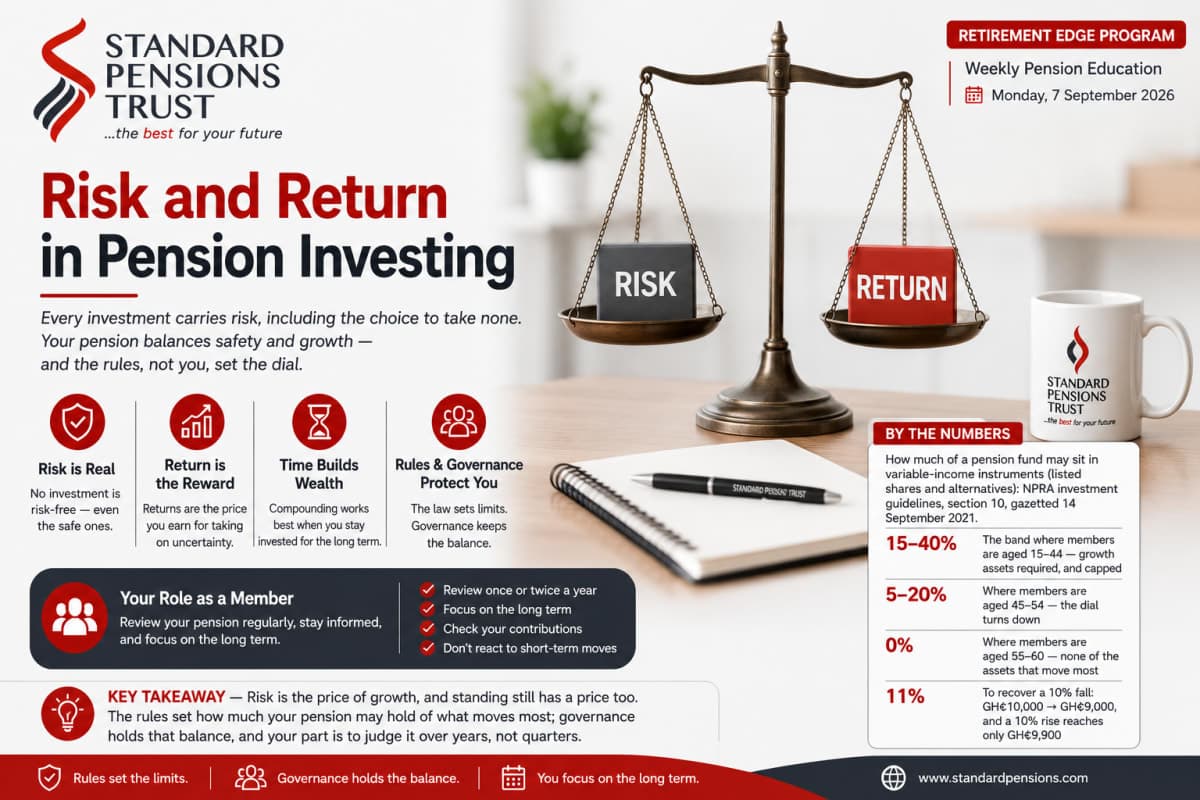
Your pension is designed to balance safety and growth. But what does investment risk really mean, and how do pension funds manage it? This week's Retirement Edge explains the relationship between risk, return, diversification and your long-term retirement savings.

Pension Transparency: What Members Should Expect from Their Trustee
Transparency is a duty you can test, not a favour you receive. Learn what you should expect from your pension trustee, from clear statements and accurate records to accessible information, member support and education.

Pension Transparency: What Members Should Expect from Their Trustee | Standard Pensions Trust
Learn what pension members should expect from their trustee, including clear statements, accurate records, transparent communication, member support and access to pension information.



Subscribe to our Newsletter
Get pension updates, retirement planning tips, and trusted insights delivered to your inbox.