
Why Pension Funds Think Long-Term
“Learn why pension funds invest for the long term, how Ghana’s pension investment rules work, and what trustees, fund managers and custodians must do to protect members.”
Why Pension Funds Think Long-Term
A market headline lands and a pension balance starts to read like a live score. It is not one. One disclosure first, because it is the point: SPT is a trustee, paid to run the schemes it asks you to be patient with. So what follows cites instruments rather than asking for trust.
The best days sit beside the worst ones
Over the twenty years to the end of 2025, ten thousand dollars left alone in the American market became $80,619; out of the market for only the ten best days, $35,866 [J.P. Morgan, Guide to Retirement 2026]. Six of those ten best days fell within two weeks of the ten worst, and five of the six came after them: the days you would most want to escape and the days you cannot afford to miss are the same fortnight. Read that figure's limits as carefully as the figure. It is one market's history and a share index at that; Ghana's pension funds hold a different mix, weighted to government securities. It promises nothing.
What is written down, and what is not
Your trustee must maintain an investment policy statement (section 121(c)), and your fund manager must manage the money in accordance with it (section 147). The Regulations say what that statement must carry: enough for scheme members to ascertain the investment objectives, the kinds of assets it may hold, the balance between them, and the risks and the return expected (L.I. 1990, regulation 23). Be exact about what that settles: the law requires a written policy, not a particular horizon. One rule does speak to time. Where a market move pushes a scheme past an NPRA investment limit, the 2021 guidelines allow sixty days to rebalance and require the NPRA to be told with a plan if that fails (section 11). It covers a breached limit and nothing else, but it is the one place the rulebook says what to do when prices move, and it says take sixty days.
Prudence has a source, and it is not the Act
Act 766 places ten functions on a licensed trustee at section 121, and not one uses the word prudent. The standard of care sits a level below, in the Regulations: an approved trustee must exercise the care, skill, diligence and prudence reasonably expected of a prudent person familiar with registered schemes, and must act in the interest of scheme members and not the trustee's own (L.I. 1990, regulation 28). Three licensed parties are involved, trustee governs, fund manager invests, custodian holds, and the Regulations require the manager and the custodian to be independent of the trustee and of each other.
What that means for you
Kojo is 34. Decades sit between him and the day his Tier 2 benefit becomes payable, so a bad month is not information about his outcome; his levers are the amount he adds and the years. Esi is 59, and her question is different, how to hold and draw that money, which belongs with a licensed adviser, not a headline.
By the numbers - Assets: NPRA 2025 Annual Report, as at 31 December 2025; Tier 2 GH¢59.1bn plus Tier 3 GH¢21.4bn, summed here, not a published combined total. Sixty days: NPRA Guidelines on Investment of Tiers 2 and 3 Pension Scheme Funds, gazetted 14 September 2021, section 11. Ten functions: Act 766 section 121. Four contents and three separate parties: Occupational and Personal Pension Schemes (General) Regulations, 2011 (L.I. 1990), regulations 23, 29(4) and 51(1)(c).
Patience is not passivity. The long view your fund is managed on is written down and owed to you by someone; the two parts that are yours are the amount you add and the years you leave it alone.
What you should do next
Main — Count the years before you react to a market number. Under the Act your Tier 2 benefit is paid when you reach retirement age, or from age fifty if you are then neither employed nor self-employed (section 101). Count the years between now and that point. If the answer runs to decades, this week is not information about your outcome, and counting costs you nothing and commits you to nothing.
Support 1 — Ask us, in writing, what your scheme's investment policy says. The law requires your trustee to maintain one and requires the fund manager to invest in line with it, and the Regulations require that statement to carry enough for members to ascertain the objectives, the assets, the balance between them and the risks and expected return. Questions about how the scheme is invested and what it costs belong with SPT in writing.
Support 2 — Keep the one question that is never a market question separate. Money deducted from your pay that does not appear on your record is not a market movement and must never be answered as one. That starts with your employer's payroll office, then SPT, and can be escalated to the NPRA. Patience is the right answer to a falling market; it is the wrong answer to a missing contribution.
In Ghana, under Act 766 — every pinpoint behind this article, in order. Trustee functions: s121, ten in all; s121(c) maintain investment policy statements and internal control procedures that may be prescribed by the Board; s121(d) ensure the scheme's investments are diversified to minimise investment risk. Fund manager: s147, manage in accordance with the scheme's investment policy statement. Standard of care and contents of the policy: Occupational and Personal Pension Schemes (General) Regulations, 2011 (L.I. 1990), regs 28 and 23. Independence of the fund manager and the custodian: L.I. 1990 regs 29(4) and 51(1)(c). Rebalancing after a limit breach: NPRA Guidelines on Investment of Tiers 2 and 3 Pension Scheme Funds, gazetted 14 September 2021, s11. The NPRA issues those guidelines under s7(c), and they set four objectives (s1.2): safety of assets and fair returns on the funds; a range of investment options for contributors; a better ability among trustees and fund managers to make sound investment decisions; and an environment in which pension funds impact positively on the Ghanaian economy. Those are aims the rules are built around, not outcomes anyone guarantees.
Get new pension insights on WhatsApp
Join the Standard Pensions Trust WhatsApp Channel to receive updates when we publish new pension education articles, guides and important member information.
Standard Pensions Trust remains committed to helping members understand their pension, protect their records, and make better retirement decisions through clear education and reliable scheme administration.
Respond to this article with emojis
0 reactions so far
Related Posts

Inflation and Retirement: The Silent Risk to Your Future Income
Learn how inflation can reduce the real value of your pension in Ghana, how Tier 1 and Tier 2 are affected, and what you can do to protect retirement income.
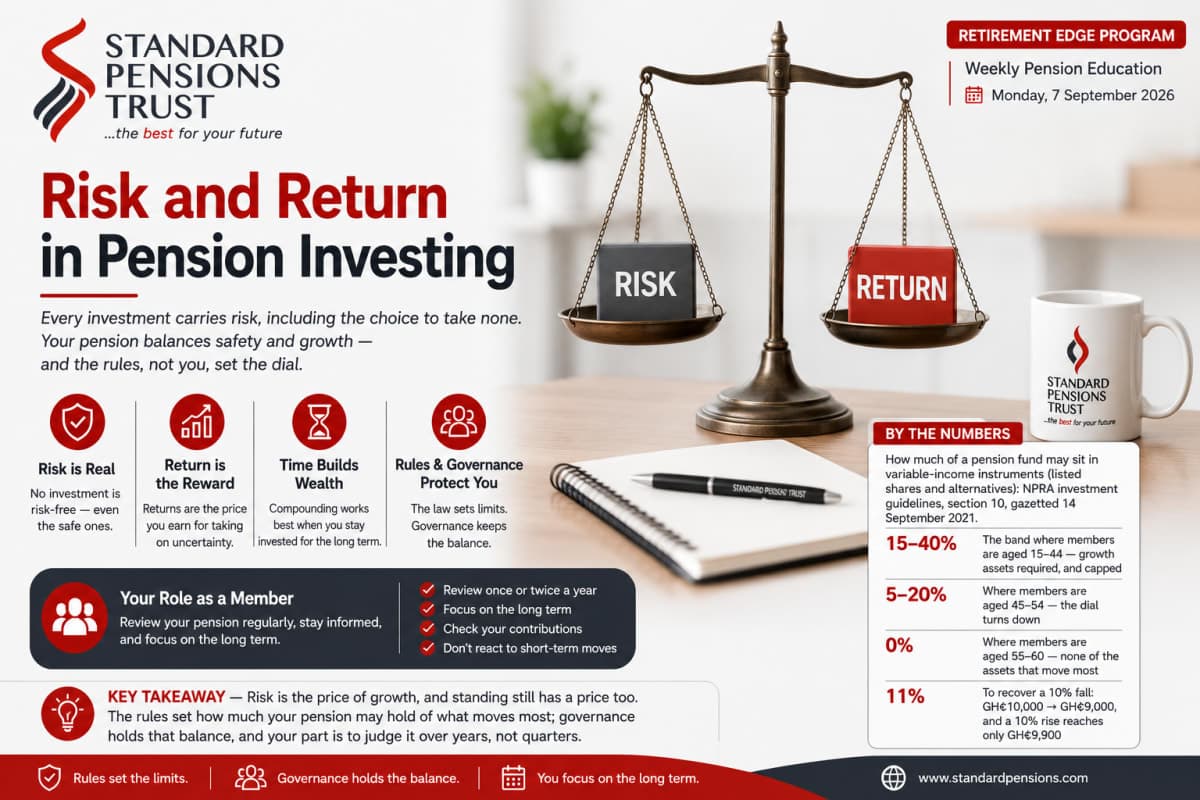
Risk and Return in Pension Investing
Your pension is designed to balance safety and growth. But what does investment risk really mean, and how do pension funds manage it? This week's Retirement Edge explains the relationship between risk, return, diversification and your long-term retirement savings.

Pension Transparency: What Members Should Expect from Their Trustee
Transparency is a duty you can test, not a favour you receive. Learn what you should expect from your pension trustee, from clear statements and accurate records to accessible information, member support and education.



Subscribe to our Newsletter
Get pension updates, retirement planning tips, and trusted insights delivered to your inbox.