
Using Your Pension Lump Sum Wisely: What to Know Before You Spend
“Your pension lump sum represents years of contributions and savings. But what happens to the legal protection once the money is paid? Understand how Tier 2 and Tier 3 benefits are paid, what deductions to check, and the important steps to take before using your retirement money.”
Weekly Pension Education · 9 Nov 2026
Using Your Pension Lump Sum Wisely
The law guards your benefits right up to the moment they are paid - and then stops. Where that line falls matters.
What arrives, and in what shape
At retirement age your whole Tier 2 accrued benefit is paid as one lump sum, and benefits under the mandatory occupational scheme are not taxable (sections 101 and 104). Tier 3 is payable in full at retirement age too, and that withdrawal is tax exempt (sections 110 and 112). One case is phased by law: a contributor covered by no mandatory scheme must use three quarters of the benefits to buy a life annuity guaranteed for fifteen years, paid monthly by an insurer licensed by the National Insurance Commission; the rest is a lump sum (regulation 126). A SSNIT pension, if you qualify, is separate (section 70).
Where the protection stops
Your accrued benefits in an occupational pension scheme cannot be attached for a judgment debt, used as a charge, pledge or lien, or transferred or assigned, and a disposition that tries is void (section 102). Funds kept with a custodian cannot pay the custodian's creditors if it is liquidated (section 209). Once the money reaches your account, neither applies. We swept all 221 sections of Act 766 and all 156 regulations of L.I. 1990 for advice, adviser, advise, counsel, financial literacy and budget: neither says how a member may use benefits after payment, or puts anyone under a duty to advise you. What ends is the pension-law protection; this pack read no other law.
What still has rules around it
Three things do. A scheme may allow a member to use the benefit to secure a mortgage for a primary residence (sections 103 and 114); section 114 adds that no tax is payable on a withdrawal under it. The NPRA has separate Mortgages Guidelines, which we have not read. Tier 3 accrued benefits may be pledged or charged - as collateral for a loan - but the contributor must consent in writing, serve a copy on the trustees, and the trustees withhold the tax due (s113; para 5(3)). Payment comes by bank transfer, e-payment platform or cheque (para 7) - not through someone who asks for a fee first.
Check the paperwork before you spend
With the payment you must be given a final benefit statement: the trustee, the scheme and the account, your name and address, the total paid and the date, and an itemised statement of any expense deducted (reg 134). Read it against your bank record. The guidelines say transfer costs shall not be charged to the member (para 7); regulation 20 bars transfer fees but allows actual and reasonable expenses of redeeming and buying units -
the itemised statement shows which applied. Our view, not a rule: money that took a working life to build need not be committed in a few weeks.
By the numbers
Act 766, L.I. 1990 and the NPRA Benefit Administration Guidelines, read 24 September 2026.
KEY TAKEAWAY
The rules protect your benefits until they are paid and itemise what was deducted. After that they are silent: neither instrument tells you what to do with the money, and nobody who says otherwise is quoting one.
What you should do next
When the payment lands, read the final benefit statement against your bank record: the amount, the date and every expense deducted (reg 134). For help reading it, ask the trustee (reg 40).
If an expense was deducted, ask which rule allowed it: transfer costs shall not be charged to the member (para 7), and reg 20 allows only actual and reasonable expenses of redeeming and buying units.
Before pledging Tier 3 benefits as collateral: your written consent must be served on the trustees, and the tax due is withheld (s113; para 5(3)).
If you want help deciding, choose the adviser yourself: no rule appoints one, your trustee is not your adviser, and it is fair to ask who licenses them.
Check the trustee named on your statement against the NPRA's lists (npra.gov.gh) and their dates. Write to the trustee (reg 40); then the NPRA, which investigates complaints of impropriety (s7); a member may ask the Board in writing to review a trustee's decision (s202).
In Ghana, under Act 766 - the pinpoints
What is paid: s101(1); s104(1) and (2); s110(1); s112(5)(a) (on or after retirement, tax exempt); reg 126(1) and (4) (75% annuity guaranteed fifteen years, 25% lump sum) with s111 ('not covered under a mandatory pension scheme or any other pension scheme'); s70(1).
Protection: s102(1) and (2) (occupational accrued benefits); s209(1) (a custodian's liquidation).
Around the payment: s103(2) and s114(2), the tax exemption in s114(2) alone; s113(1) and (2) with Benefit Administration Guidelines NPRA/GD/BAP/01/24 (Gazette No. 13, 21 January 2025; OCR twice) para 5(3)(a) and (c); reg 20; para 7(1); regs 132(1) and (2), 134(a) to (d), 137(1) and (2).
Redress: reg 40(1); s7(j) and (l); s202(1).
Swept: advice, adviser, advise, counsel, financial literacy and budget across all 221 sections and 156 regulations - neither governs money after payment. Act 766 and L.I. 1990 read 24 September 2026; the Mortgages Guidelines not read.
Standard Pensions Trust pays these benefits and does not advise on them: the choice after payment is yours alone.
Disclaimer
General pension education from Standard Pensions Trust under the Retirement Edge Program. Standard Pensions Trust is a corporate trustee (listed on the NPRA's licensed-trustee notice dated 30 April 2026) paid to run Tier 2 and Tier 3 schemes and to pay these benefits, so it has a direct interest in how the payment is described; it is not an adviser. It explains the National Pensions Act, 2008 (Act 766) as amended, the Occupational and Personal Pension Schemes (General) Regulations, 2011 (L.I. 1990) and NPRA guidelines published in the Gazette, as read on 24 September 2026. It is written for a member claiming their own benefit and does not cover benefits paid after a member's death. It is not personalised financial, tax, investment or legal advice, recommends no use of any money, states no tax rate and promises no return. Rules may change: confirm current requirements with the NPRA.
Respond to this article with emojis
0 reactions so far
Related Posts

Approaching Retirement in Ghana: What to Check Before You Exit Work
Learn what to check before retirement in Ghana. Understand Tier 2 pension notices, contribution records, claim requirements, payment timelines and steps to secure your retirement benefits.
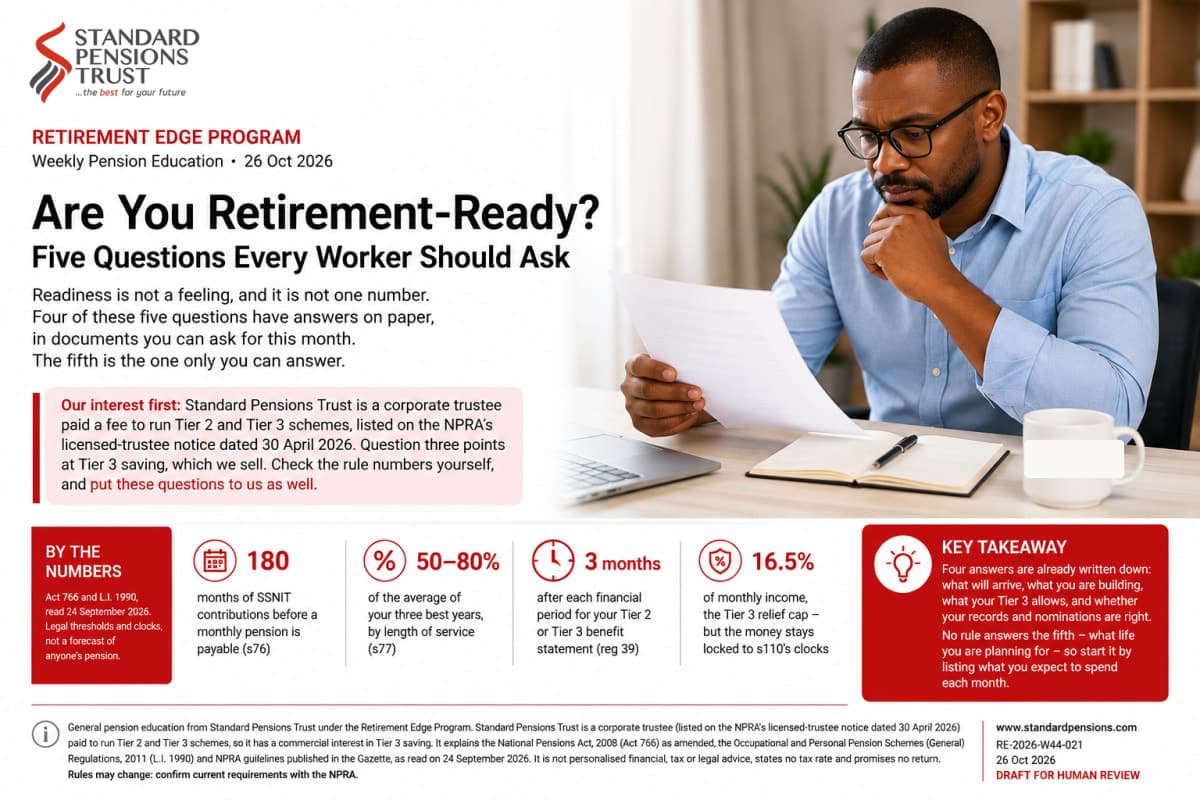
Are You Retirement-Ready? Five Questions Every Worker Should Ask
Readiness is not a feeling, and it is not one number. Explore five questions every worker should ask about SSNIT pension eligibility, Tier 2 benefits, Tier 3 savings, benefit statements, records and nominations—and start planning for the life you want in retirement.

What Makes a Good Pension Trustee? 4 Regulatory Tests Beyond Fees
Fees are easy to compare, but they cannot tell you whether your pension records are accurate or your complaints addressed. Discover the four core legal tests under Ghana’s Act 766 and NPRA guidelines to properly evaluate your pension trustee



Subscribe to our Newsletter
Get pension updates, retirement planning tips, and trusted insights delivered to your inbox.