
Approaching Retirement in Ghana: What to Check Before You Exit Work
“Learn what to check before retirement in Ghana. Understand Tier 2 pension notices, contribution records, claim requirements, payment timelines and steps to secure your retirement benefits.”
Approaching Retirement: What to Check Before You Exit Work
The rules do notify you before you turn 60. But nothing is paid until you lodge a claim, and the gaps that are cheap to fix now become expensive the day you stop working.
Our interest first: Standard Pensions Trust is a corporate trustee (on the NPRA's licensed-trustee notice dated 30 April 2026) paid to run Tier 2 and Tier 3 schemes, so we are the body a member lodges a claim with. The clocks below bind us as much as any trustee; hold us to them.
Three years out, the notices begin
Under the NPRA's benefit guidelines, your trustee must notify you three years before you reach the compulsory retirement age of 60 - the formal-sector age; an informal scheme sets its own (regulation 156). The same notice goes to your employer, who must confirm who is nearing retirement, and if you do not respond further notices follow within six months. Three months before 60 a second notice asks you to complete an application form (para 4). You lodge that claim yourself: your employer confirms your record, it does not claim for you.
Check the record while it can still be fixed
Your benefit statement must show the contributions paid and any period for which none was paid (L.I. 1990, regulation 39). Put your payslips beside it. Where a month is missing, ask payroll in writing: an employer must reply within fourteen days (regulation 110) and must remit within fourteen days of each month's end (Act 766, section 3(3)). Arrears carry a surcharge of three per cent a month (regulation 102). No employer to ask? Write to your trustee directly; the claim and its clocks are the same.
The claim itself: form, documents, clocks
A claim is lodged with the trustee on a form the NPRA specifies or approves (regulation 125), with the documents your route requires and your Ghana Card or other approved national ID (benefit guidelines, para 3). Voluntary retirement at 55 or above adds evidence that you have reached your scheme's early retirement age, a statutory declaration - a sworn written statement - your written notice to your employer and the employer's acknowledgement (regulation 127; para 4(2)). At 50 or over and out of work it adds a certification of unemployment from the Labour Department, and payment there runs thirty days from the NPRA's no-objection notice, not from lodgment (para 4(2)).
Then the clocks, and what happens if you wait
A valid claim is paid within thirty days of lodgment where no contributions are outstanding, or sixty where they are; if recovery fails after sixty days you may take a partial withdrawal of what is there while the trustee keeps pursuing the rest (regulation 132; para 6). Payment stops only while the NPRA has served notice of an audit or investigation, unless it consents in writing (regulation 133). Reaching 60 pays you nothing by itself: if you do not lodge, the trustee must write within twelve months, and with no reply in six months and no way to trace you the benefits are registered as unclaimed and reported to the NPRA (regulations 137 and 139). Nothing is forfeited; nothing moves either. A SSNIT pension is paid monthly once its conditions are met, and filing the application is one (section 76).
By the numbers
L.I. 1990 and the NPRA Benefit Administration Guidelines, read 24 September 2026.
Clocks the rules set, not a service promise by any trustee.
Key Takeaway
The system notifies you; it pays when you lodge, and you lodge it yourself. Fix the contribution record while your employer can still fix it, and put the claim in at the three-month notice, not after you have left.
What you should do next
Main — Ask your trustee - its name is on your statement - in writing for an up-to-date benefit statement and the claim form and document list for your route (reg 39; reg 125; para 3).
Support 1 — Reconcile your payslips against the statement's unpaid periods, and query any gap with payroll in writing; they must reply within fourteen days (reg 110).
Support 2 — Retiring voluntarily at 55 or above? Lodge your employer's acknowledgement of your notice, evidence of your scheme's early retirement age and a statutory declaration (reg 127; para 4(2)).
Support 3 — Confirm how you will be paid - bank transfer, e-payment or cheque - and keep the final benefit statement that must come with it (reg 134; para 7).
Already past 60 and never claimed — The same form, documents and clocks apply. Ask your trustee for them, in writing, today (reg 125; reg 137).
If it stalls — The rules set no deadline for a trustee's reply, only for payment: thirty or sixty days from lodgment (reg 132). A trustee must assist as far as reasonably practicable (reg 40); once the clock passes, write to the NPRA (s7), which may be asked to review a trustee's decision (s202).
In Ghana, under Act 766 - the pinpoints. Notices and claims: NPRA Benefit Administration Guidelines (Gazette No. 13, 21 January 2025; OCR read twice) paras 3(1) and (2), 4(1)(a)(i) to (vi), 4(1)(b) and (c), 4(2)(a) and (b), 6 and 7(1); L.I. 1990 regs 125(1) to (3), 127(3), 129, 132(1) and (2), 133(1), 134(a) to (d), 137(1) and (2), 139(1). Records and arrears: regs 39(1) and (3), 102, 108, 110, 119; s3(3). Entitlement: s101(1); s110(1) and (2); s112(5), which exempts a withdrawal on or after retirement; reg 126 (a contributor in no mandatory scheme); reg 156 (retirement age). Tier 1: s70(1); s76(1), including the application. Redress: reg 40; s7(j); s202.
Act 766 and L.I. 1990 read on 24 September 2026 from the government-domain copies. No service level of any trustee, and no tax rate, is stated here.
These clocks bind every trustee, Standard Pensions Trust included: put your request in writing and hold us to them.
Respond to this article with emojis
0 reactions so far
Related Posts
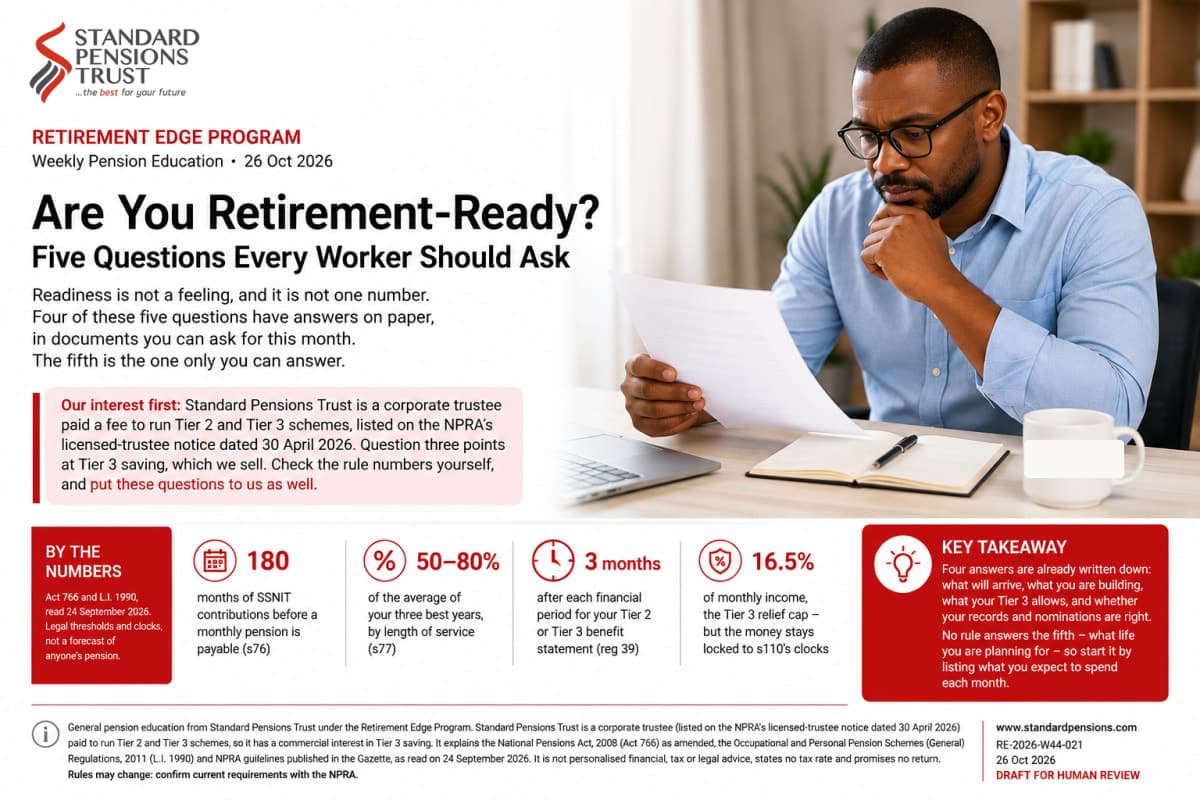
Are You Retirement-Ready? Five Questions Every Worker Should Ask
Readiness is not a feeling, and it is not one number. Explore five questions every worker should ask about SSNIT pension eligibility, Tier 2 benefits, Tier 3 savings, benefit statements, records and nominations—and start planning for the life you want in retirement.

What Makes a Good Pension Trustee? 4 Regulatory Tests Beyond Fees
Fees are easy to compare, but they cannot tell you whether your pension records are accurate or your complaints addressed. Discover the four core legal tests under Ghana’s Act 766 and NPRA guidelines to properly evaluate your pension trustee

Pension Governance: Who Protects the Member’s Interest?
Who is responsible for protecting your pension? Discover how trustees, fund managers, custodians and the NPRA work together to support accountability and protect pension members in Ghana. This week’s Retirement Edge explains the roles behind pension governance and what you can do to stay informed about your retirement savings.



Subscribe to our Newsletter
Get pension updates, retirement planning tips, and trusted insights delivered to your inbox.